
Vasomotor Rhinitis
Introduction
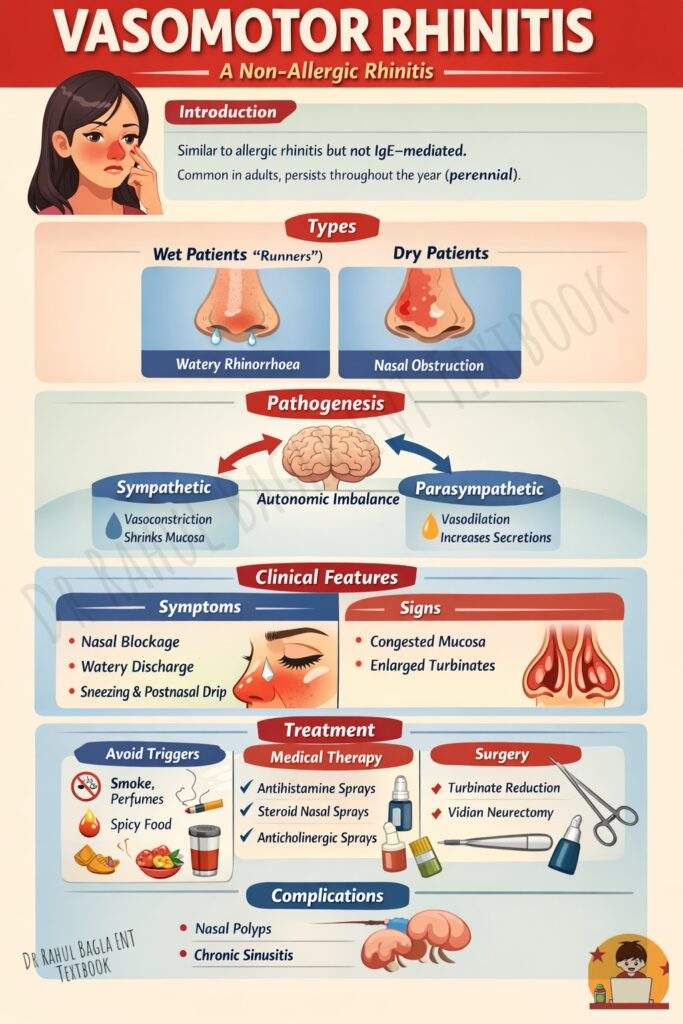
Vasomotor rhinitis is a type of non-allergic rhinitis that clinically resembles allergic rhinitis. However, it does not involve IgE-mediated hypersensitivity. Therefore, vasomotor rhinitis is diagnosed only after excluding allergic rhinitis through history, examination, and allergy testing. Vasomotor rhinitis usually persists throughout the year (perennial) and affects adults more commonly than children.
Types of Vasomotor Rhinitis
- Wet Patients (“Runners”). These patients develop excessive watery rhinorrhoea. Nasal discharge becomes the dominant symptom. There is increased cholinergic glandular secretory activity.
- Dry Patients. These patients mainly develop nasal obstruction and airflow resistance. They usually have little or no rhinorrhoea. There is increased nociceptive (sensory) neurons activity with heightened sensitivity to usually innocuous stimuli.
Pathogenesis
The exact cause of VMR remains uncertain, but it is believed that autonomic nervous system imbalance plays a major role. The nasal mucosa has a rich blood supply. Its blood vessels contain venous sinusoids, which behave like erectile tissue. These sinusoids fill or empty depending on autonomic stimulation.
- Sympathetic stimulation causes vasoconstriction, which shrinks the nasal mucosa and improves airflow.
- Parasympathetic stimulation causes vasodilation, which engorges the mucosa and increases nasal secretions.
In vasomotor rhinitis, the parasympathetic system becomes overactive. As a result, patients develop mucosal swelling and excessive glandular secretion. In addition, the nasal mucosa becomes hyper-reactive. Therefore, it responds strongly to minor environmental stimuli, such as changes in temperature or humidity, cold air blasts, and dust or smoke. The hypothalamus controls the autonomic nervous system, so emotional factors and stress can also trigger vasomotor symptoms.
Recent theories suggest that VMR may result from non-IgE–mediated inflammation, increased nasal mucosal permeability, and abnormal nerve (neurogenic) responses in the nose. As a result, the nasal lining becomes highly sensitive to minor stimuli such as cold air, smoke, or strong smells.
Clinical features
Symptoms. Patients typically present with persistent nasal obstruction, profuse watery rhinorrhoea, paroxysmal sneezing (especially in the morning), and postnasal drip; allergy tests remain negative. Moreover, various environmental triggers such as temperature change, strong odours, smoke, spicy food, and emotional stress may precipitate symptoms.
Signs. On anterior rhinoscopy: Congested nasal mucosa, Hypertrophied turbinates and occasionally normal mucosa
Complications. Long-standing vasomotor rhinitis may lead to hypertrophic rhinitis, nasal polyps and chronic rhinosinusitis.
Diagnosis. Diagnosis remains clinical because no specific test confirms VMR.
Treatment
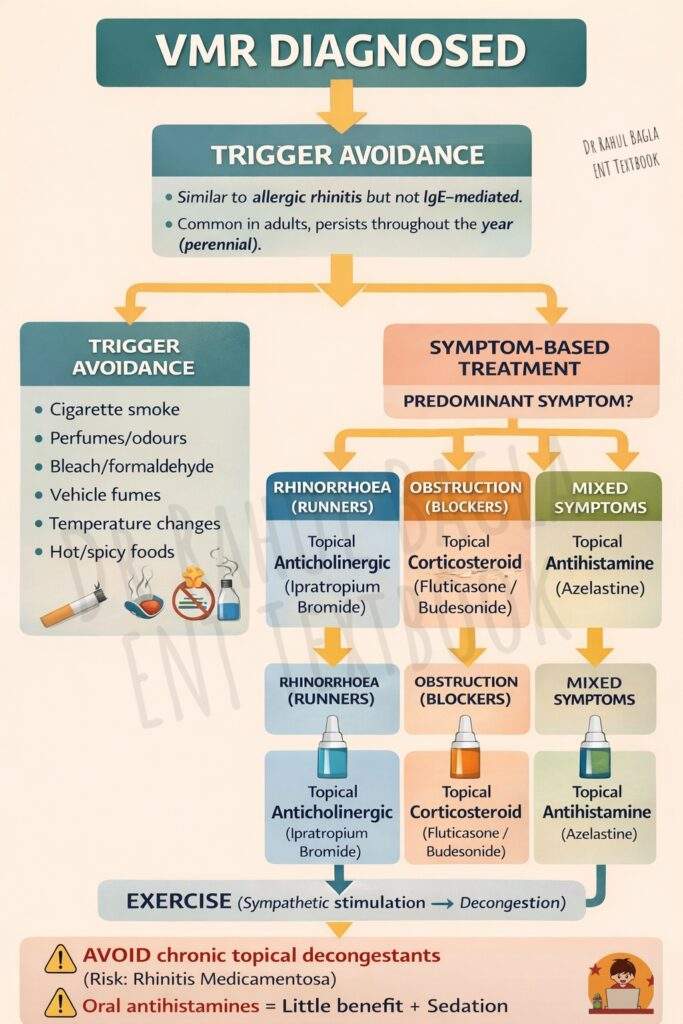
- Avoid Triggers. Patients should avoid environmental triggers that worsen symptoms, such as cigarette smoke, perfumes and strong odours, bleach and formaldehyde, vehicular emission fumes, sudden temperature changes and hot or spicy foods.
- Medical Treatment. Treatment depends on the dominant symptom.
- Predominant rhinorrhoea. Use topical anticholinergic nasal spray.
- Predominant nasal obstruction. Use topical corticosteroid nasal spray.
- Multiple symptoms (rhinorrhoea, sneezing, congestion). Use topical antihistamine nasal spray. Oral antihistamines provide little benefit in vasomotor rhinitis and may cause sedation. One should avoid long-term use of topical decongestants because they can cause rhinitis medicamentosa (rebound nasal congestion).
- Exercise. Regular exercise improves nasal airflow. Exercise stimulates the sympathetic nervous system, which produces nasal decongestion and improves breathing.
- Surgical management. Surgery is considered when medical treatment fails.
——– End——–
Reference Textbooks.
- Scott-Brown, Textbook of Otorhinolaryngology-Head and Neck Surgery.
- Cummings, Otolaryngology-Head and Neck Surgery.
- Stell and Maran’s, Textbook of Head and Neck Surgery and Oncology.
- Ballenger’s, Otorhinolaryngology Head And Neck Surgery
- Susan Standring, Gray’s Anatomy.
- Frank H. Netter, Atlas of Human Anatomy.
- B.D. Chaurasiya, Human Anatomy.
- P L Dhingra, Textbook of Diseases of Ear, Nose and Throat.
- Hazarika P, Textbook of Ear Nose Throat And Head Neck Surgery Clinical Practical.
- Mohan Bansal, Textbook of Diseases of Ear, Nose and Throat Head and Neck Surgery.
- Hans Behrbohm, Textbook of Ear, Nose, and Throat Diseases With Head and Neck Surgery.
- Logan Turner, Textbook of Diseases of The Nose, Throat and Ear Head And Neck Surgery.
- Arnold, U. Ganzer, Textbook of Otorhinolaryngology, Head and Neck Surgery.
- Ganong’s Review of Medical Physiology.
- Guyton & Hall Textbook of Medical Physiology.
Author:

Dr. Rahul Bagla
MBBS (MAMC, Delhi) MS ENT (UCMS, Delhi)
Fellow Rhinoplasty & Facial Plastic Surgery.
Renowned Teaching Faculty
Mail: msrahulbagla@gmail.com
India
———– Follow us on social media ————
- Follow our Facebook page: https://www.facebook.com/Dr.Rahul.Bagla.UCMS
- Follow our Instagram page: https://www.instagram.com/dr.rahulbagla/
- Subscribe to our Youtube channel: https://www.youtube.com/@Drrahulbagla
- Please read. Anatomy of External Ear. https://www.entlecture.com/anatomy-of-ear/
- Please read. Anatomy of Temporal Bone. https://www.entlecture.com/anatomy-of-temporal-bone/
- Please read. Stenger’s, Chimani Moos, Teal test. https://www.entlecture.com/special-tuning-fork-tests/
Keywords: Vasomotor rhinitis notes for MBBS students, Vasomotor rhinitis ENT exam guide, Vasomotor rhinitis NEET PG MCQs, Non-allergic rhinitis causes and treatment ENT, Vasomotor rhinitis symptoms diagnosis management, Vasomotor rhinitis summary ENT residents, Difference between allergic rhinitis and vasomotor rhinitis, Vasomotor rhinitis CBME ENT notes, Vidian neurectomy indications ENT, Rhinorrhoea causes ENT revision notes