
|
The following CBME core competencies are covered in this chapter.
|
Embryology of Nose and Paranasal Sinuses
Introduction
Embryology of the nose and paranasal sinuses explains how the face, external nose, nasal cavities, palate, and paranasal sinuses develop during fetal life. Embryology of the nose and paranasal sinuses explains many clinical conditions, surgical landmarks, and anatomical variations. Understanding these developmental processes helps MBBS students and ENT postgraduate residents interpret congenital anomalies such as choanal atresia and cleft palate, understand CT anatomy, and perform functional endoscopic sinus surgery (FESS). This chapter provides CBME-aligned notes, high-yield revision points, diagrams, flowcharts, viva questions, and NEET PG concepts in one comprehensive resource.
Chronology of Nose and Paranasal Sinus Development
- Week 4 (Facial development) → Five facial prominences → Nasal placodes
- Week 5 (Nasal cavity development) → Nasal pits Week 6 → Nasal sacs → Primitive choana → Medial & lateral nasal prominences
- Week 6–7 (Facial & Nasal development) → Fusion with maxillary prominence → Upper lip + nasal cavity
- Week 7–8 (Palate development) → Primary palate
- Week 8–12 (Palate development) → Secondary palate
- Week 7–16 (Paranasal sinus development) → Paranasal sinus development (Maxillary → Ethmoid → Sphenoid → Frontal)
Development of the Face
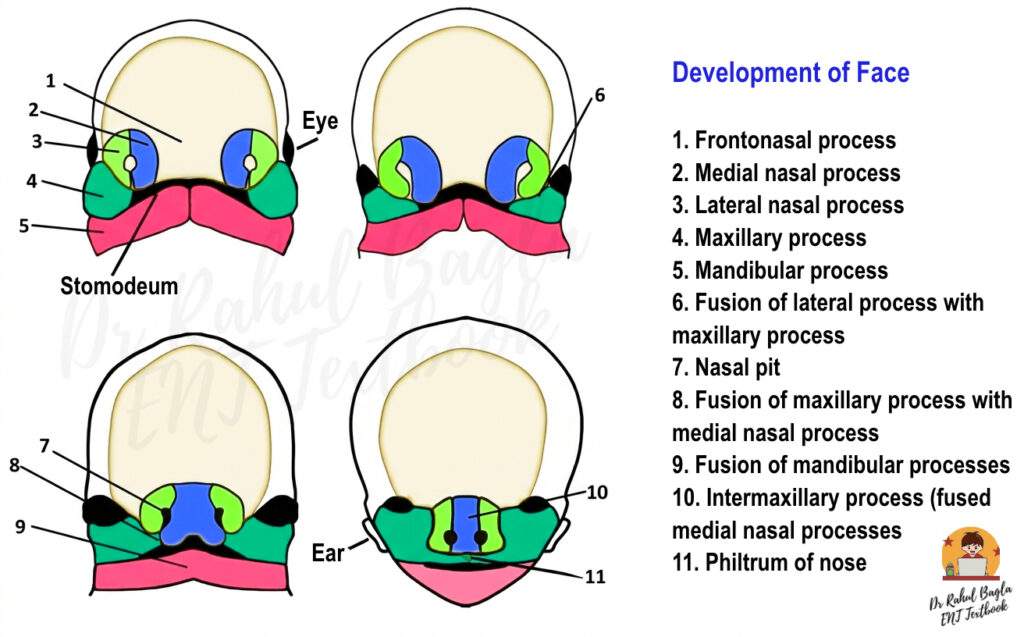
Facial development begins in the 4th week of gestation. Five facial prominences (also called facial swellings) develop around the stomodeum (primitive mouth), which lies below the developing brain. These prominences form the basic framework of the face.
The Five Facial Prominences are:
- Frontonasal Prominence: Forms the forehead and the bridge of the nose.
- Right & Left Maxillary Prominence: Form the cheeks and upper lip.
- Right & Left Mandibular Prominence: Form the lower jaw.
All nasal structures develop through interaction between the frontonasal and maxillary prominences.
Embryological Note: Most of the connective tissue, cartilage, and bone of the developing face are derived from neural crest-derived ectomesenchyme (neural crest-derived mesenchyme), which surrounds the facial prominences and plays a central role in facial morphogenesis.
Development of the External Nose and Nasal Cavities
- Stage 1: Formation of Nasal Placodes (Week 4–5). Ectoderm on the frontonasal prominence thickens to form nasal placodes. These placodes lie superior and lateral to the stomodeum. These oval placodes develop into the nose. They represent the earliest sign of nasal development. The nasal placodes also give rise to the olfactory epithelium, which contains the receptor cells responsible for the sense of smell.
- Stage 2: Formation of Nasal Pits (Week 5–6). By the 5th week, mesenchyme around each placode proliferates and grows. This growth pushes the placodes inward and forms depressions, known as nasal pits.
- Stage 3: Formation of Nasal Sacs and Primitive Choanae (Week 6). The nasal pits deepen to form nasal sacs, which grow toward the oral cavity. A thin oronasal (bucconasal) membrane separates the nasal and oral cavities at this stage. This membrane later ruptures to form the primitive choanae. The definitive choanae are established later after formation of the secondary palate, which separates the nasal cavity from the oral cavity. Clinical correlation: Failure of this membrane to rupture leads to choanal atresia. Choanal atresia is more commonly unilateral than bilateral and may occur as part of CHARGE syndrome.
- Stage 4: Formation of Medial and Lateral Nasal Processes. Proliferation of neural crest-derived mesenchyme around each nasal placode forms the medial and lateral nasal prominences, which surround the nasal pits. These processes shape the nostrils (nares). The medial nasal process forms the septum, philtrum, and primary palate. The lateral nasal prominence primarily forms the alae (wings) of the nose.
- Stage 5: Fusion with Maxillary Prominence (Week 6–7). By the end of the 6th week, the maxillary prominences grow medially and fuse with the paired medial nasal prominences. This fusion contributes to the formation of the upper lip, upper jaw, and separates the nasal and oral cavities. This fusion forms the separate nasal cavities. At the junction of the lateral nasal and maxillary prominence, ectoderm thickens to form epithelial cords that later canalise into the nasolacrimal duct and lacrimal sac. The bridge and nasal bones develop predominantly from the frontonasal prominence, whereas the lateral nasal prominence primarily forms the alae of the nose.
Flowchart: Frontonasal Prominence → Nasal Placodes → Nasal Pits →Nasal Sacs → Rupture of Bucconasal Membrane → Primitive Choanae → Formation of Medial & Lateral Nasal Prominences → Fusion with Maxillary Prominences → Definitive Nasal Cavities → Formation of Primary & Secondary Palate
Table: Clinical Correlations
| Developmental Error | Clinical Condition |
| Persistence of bucconasal membrane | Choanal atresia |
| Failure of medial nasal and maxillary fusion | Cleft lip |
| Failure of palatal shelf fusion | Cleft palate |
| Failure of fusion of medial nasal prominences | Midline facial defects (rare) |
Development of the Upper Lip and Palate
Formation of the Upper Lip
Between the 7th and 8th weeks, the two medial nasal processes fuse with the maxillary prominence. Consequently, this fusion forms the central part of the upper lip (philtrum) and the primary palate. However, if this fusion fails, a cleft lip occurs. Therefore, the mesenchyme must penetrate these junctions to ensure a solid union of the upper jaw.
Formation of the Palate: Primary vs. Secondary
The palate originates from two distinct embryological sources:
- Primary Palate: Develops from the intermaxillary segment, which is formed by fusion of the paired medial nasal prominences. It eventually becomes the premaxilla, which holds the upper incisor teeth. Intermaxillary Segment: The fused medial nasal prominences form the intermaxillary segment, which gives rise to the philtrum of the upper lip, the premaxilla (bearing the incisor teeth), and the primary palate.
- Secondary Palate: Formed by the palatal shelves (outgrowths of the maxillary prominence). Initially, these shelves grow vertically alongside the tongue. However, as the mandible grows and the tongue drops, the shelves elevate to a horizontal position above the tongue and fuse in the midline, with the primary palate anteriorly, and with the descending nasal septum superiorly.
Clinical Note: The incisive foramen serves as the landmark dividing the primary and secondary palate. Failure of fusion of the palatal shelves results in cleft palate. Cleft palate may be complete, incomplete, or submucous, depending on the extent of failure of palatal fusion. Submucous cleft palate results from incomplete fusion of the underlying muscles despite an intact mucosal covering.
Development of the Paranasal Sinuses (PNS)
The sinuses develop as diverticula of the nasal mucous membrane. While some are present at birth, others appear much later.
Table: Summary of Sinus Development
| Sinus | Appearance (Gestation/Age) | Radiologically Visible | Adult Size Reached |
| Maxillary | 7–10 Weeks (Gestation) | At birth | 17–18 Years |
| Ethmoid | 9–10 Weeks (Gestation) | At birth | 12 Years |
| Sphenoid | 12 Weeks (Gestation) | 3 Years | 18 Years |
| Frontal | 16 Weeks (Gestation) | 8 Years | 18 Years |
Maxillary Sinus
The maxillary sinus is the first paranasal sinus to develop. It arises during fetal life as an outgrowth (diverticulum) of the lateral nasal wall through the ethmoidal infundibulum of the middle meatus into the developing maxilla. Progressive pneumatization produces a small but well-defined sinus that is present at birth. The maxillary sinus enlarges continuously throughout childhood. Its most rapid growth occurs during the first seven years of life and again during puberty, reaching its adult size by approximately 17–18 years of age.
Ethmoid Sinus
The ethmoid sinus develops from multiple invaginations of the lateral nasal wall. During the 9th and 10th weeks of gestation, four or five longitudinal folds, known as the ethmoturbinals, appear on the lateral nasal wall. These folds are separated by corresponding grooves and give rise to several important anatomical structures. The ethmoid air cells subsequently develop between these structures.
Consequently, these folds give rise to specific structures:
- 1st Ethmoturbinal: Agger nasi and Uncinate process.
- 2nd Ethmoturbinal: Bulla ethmoidalis.
- 3rd Ethmoturbinal: Basal lamella of the middle turbinate (Crucial for FESS surgery).
- 4th Ethmoturbinal: Superior turbinate
- 5th Ethmoturbinal: Supreme turbinate. The supreme turbinate is absent in many individuals.
Clinical Pearl
The basal (ground) lamella of the middle turbinate is an important surgical landmark during functional endoscopic sinus surgery (FESS) because it separates the anterior and posterior ethmoid air cells.
Sphenoid Sinus
The sphenoid sinus begins to develop during the 12th week of gestation as a posterior extension of the posterior ethmoid air cells into the sphenoid bone through the sphenoethmoidal recess. A small sphenoid sinus is present at birth. Pneumatization progresses slowly during childhood, accelerates after approximately 3 years of age, and usually reaches adult size during adolescence.
Types of Sphenoid Sinus Pneumatization
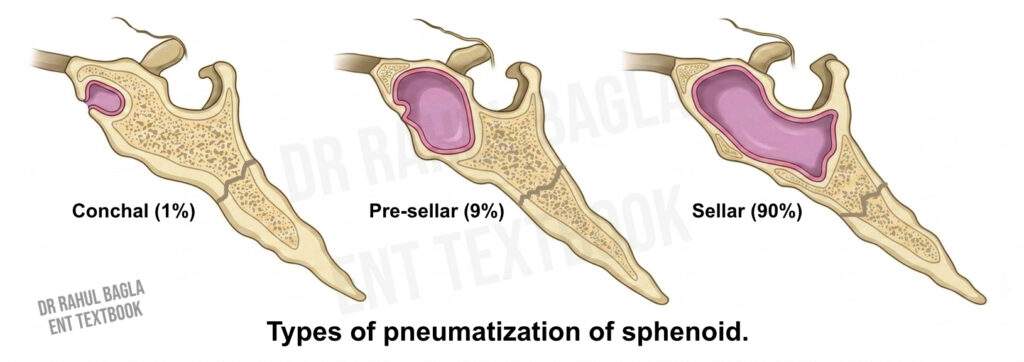
The extent of sphenoid sinus pneumatization is classified into three types, according to its relationship with the sella turcica.
- Sellar (90%): Most common; pneumatization extends behind the sella.
- Pre-sellar (9%): Pneumatization reaches the anterior wall of the sella.
- Conchal (1%): Minimal or absent pneumatization; makes transsphenoidal surgery difficult.
Clinical Pearl
The degree of sphenoid sinus pneumatization is an important consideration before transsphenoidal pituitary surgery. The conchal type provides limited surgical access because of minimal pneumatization, whereas the sellar type offers the most favourable anatomical corridor.
Frontal Sinus
The frontal sinus is the most variable paranasal sinus in terms of size, shape, and degree of pneumatization. It develops during the 16th week of gestation as an upward extension of the anterior ethmoidal air cells into the frontal bone.
At birth, the frontal sinus is represented only by a rudimentary frontal recess or small blind pouch and is usually not visible on plain radiographs. Progressive pneumatization occurs throughout childhood. The frontal sinus becomes identifiable on plain radiographs in most children by 5–8 years of age and usually reaches its adult size by approximately 18 years of age.
Clinical Pearl
The frontal sinus exhibits marked anatomical variation and may be hypoplastic, asymmetrical, or even absent (aplasia). These variations are important during functional endoscopic sinus surgery (FESS) and frontal sinus surgery.
Table: Important Clinical Correlations
| Developmental Error | Clinical Condition |
| Bucconasal membrane persistence | Choanal atresia |
| Maxillary–medial nasal fusion failure | Cleft lip |
| Palatal shelf fusion failure | Cleft palate |
| Pneumatization of the middle turbinate | Concha bullosa |
| Abnormal sphenoid pneumatization | Pituitary surgery risk |
———— End of the chapter ————
High-Yield Points for Quick Revision
- Facial development begins in Week 4.
- Nose develops from the frontonasal prominence.
- Nasal placodes are the first sign of nasal development.
- Maxillary sinus develops first.
- Frontal sinus develops last.
- Primitive choana forms after rupture of the bucconasal membrane.
- Definitive choana forms after secondary palate development.
- Choanal atresia results from persistence of the bucconasal membrane.
- Cleft lip results from failure of fusion of the medial nasal and maxillary prominences.
- Cleft palate results from failure of fusion of the palatal shelves.
- Basal lamella separates anterior and posterior ethmoid air cells.
- Sellar sphenoid sinus is the commonest type (≈90%).
Commonly Asked Questions in Viva
- What is Embryology of the Nose? Embryology of the nose is the study of fetal development of the external nose, nasal cavities, palate, and paranasal sinuses from the 4th week of gestation until birth.
- Which sinus develops first? The maxillary sinus is the first paranasal sinus to develop.
- Which sinus develops last? The frontal sinus develops last.
- What causes choanal atresia? Persistence of the bucconasal membrane causes choanal atresia.
- What causes cleft lip? Failure of fusion between the medial nasal prominence and maxillary prominence causes cleft lip.
- What causes cleft palate? Failure of fusion of the palatal shelves causes cleft palate.
———— End ————
Download the full PDF Link:
Reference Textbooks.
- Scott-Brown, Textbook of Otorhinolaryngology-Head and Neck Surgery.
- Cummings, Otolaryngology-Head and Neck Surgery.
- Stell and Maran’s, Textbook of Head and Neck Surgery and Oncology.
- Ballenger’s, Otorhinolaryngology Head And Neck Surgery
- Susan Standring, Gray’s Anatomy.
- Frank H. Netter, Atlas of Human Anatomy.
- B.D. Chaurasiya, Human Anatomy.
- P L Dhingra, Textbook of Diseases of Ear, Nose and Throat.
- Hazarika P, Textbook of Ear Nose Throat And Head Neck Surgery Clinical Practical.
- Mohan Bansal, Textbook of Diseases of Ear, Nose and Throat Head and Neck Surgery.
- Hans Behrbohm, Textbook of Ear, Nose, and Throat Diseases With Head and Neck Surgery.
- Logan Turner, Textbook of Diseases of The Nose, Throat and Ear Head And Neck Surgery.
- Arnold, U. Ganzer, Textbook of Otorhinolaryngology, Head and Neck Surgery.
- Ganong’s Review of Medical Physiology.
- Guyton & Hall Textbook of Medical Physiology.
Author:

Dr. Rahul Bagla
MBBS (MAMC, Delhi) MS ENT (UCMS, Delhi)
Fellow Rhinoplasty & Facial Plastic Surgery.
Renowned Teaching Faculty
Mail: msrahulbagla@gmail.com
India
———– Follow us on social media ————
- Follow our Facebook page: https://www.facebook.com/Dr.Rahul.Bagla.UCMS
- Follow our Instagram page: https://www.instagram.com/dr.rahulbagla/
- Subscribe to our Youtube channel: https://www.youtube.com/@Drrahulbagla
- Please read. Anatomy of External Ear. https://www.entlecture.com/anatomy-of-ear/
- Please read. Anatomy of Temporal Bone. https://www.entlecture.com/anatomy-of-temporal-bone/
- Please read. Stenger’s, Chimani Moos, Teal test. https://www.entlecture.com/special-tuning-fork-tests/
Keywords: Simplified embryology for quick revision.✔ Nasal placode ✔ Medial & lateral processes ✔ Cleft anomaliesPerfect for viva & theory exams. Embryology Of Nose And Paranasal Sinuses Notes For MBBS, Embryology Of Nose Summary For NEET PG, Development Of Nasal Cavity Easy Explanation, Paranasal Sinus Development Timeline Chart, Choanal Atresia Embryology Viva Questions, CBME ENT Embryology Notes PDF, Nasal Placode Development Explanation, Maxillary Sinus Development Age And Growth, Ethmoid Sinus Present At Birth Concept, Frontal Sinus Development Radiology Age, Sphenoid Sinus Pneumatization Types Exam, ENT Embryology Mnemonics For Revision, Development Of Palate And Nasal Septum Notes, Clinical Embryology Of Nose MCQs With Answers, NEET PG High Yield ENT Embryology, Applied Embryology For FESS Surgery Understanding, Lateral Nasal Wall Development Turbinates Explanation, Medical Students ENT Embryology Exam Guide