
Non-Allergic Rhinitis: Symptoms, Treatment, Notes & MCQs
What is non-allergic rhinitis?
Non-allergic rhinitis (NAR) is a group of rhinitis disorders in which patients develop symptoms such as nasal obstruction, watery rhinorrhoea, sneezing and postnasal drip without an identifiable allergic cause. Unlike allergic rhinitis, symptoms are not primarily driven by an IgE-mediated response to specific allergens.
Non-allergic rhinitis is common in adults and often produces perennial symptoms. Typical triggers include cold air, sudden temperature changes, smoke, pollution, perfumes, strong odours, chemical fumes and eating. Idiopathic or vasomotor rhinitis is an important form of NAR and is characterised by exaggerated nasal responses to non-specific stimuli.
Diagnosis is mainly clinical and requires appropriate evaluation for allergic rhinitis, structural nasal disease, chronic rhinosinusitis, medication-related rhinitis and other causes. Treatment is symptom-directed. Intranasal antihistamines or corticosteroids may be used for several symptom patterns, while intranasal ipratropium is particularly useful when watery rhinorrhoea predominates.
The chapter covers the classification, symptoms, pathophysiology, diagnosis and treatment of non-allergic rhinitis, along with an allergic vs non-allergic rhinitis comparison, high-yield revision points, viva questions and NEET PG/INI-CET/FMGE-style MCQs.
Definition
Non-allergic rhinitis is a group of rhinitis disorders characterised by nasal symptoms such as obstruction, rhinorrhoea and sneezing without an identifiable allergic cause.
Types of non-allergic rhinitis
Non-allergic rhinitis can be broadly classified according to the underlying clinical setting or mechanism.
- Idiopathic/vasomotor rhinitis: Nasal hyperreactivity to non-specific environmental stimuli
- Occupational rhinitis: Symptoms related to workplace exposure
- Hormonal rhinitis: Pregnancy or other hormonal changes
- Drug-induced rhinitis: Symptoms associated with systemic or topical medications
- Rhinitis medicamentosa: Rebound congestion after prolonged topical decongestant use
- NARES: Rhinitis with nasal eosinophilia despite negative allergy testing
- Gustatory rhinitis: Watery rhinorrhoea triggered by eating, especially spicy foods
1. Idiopathic/Vasomotor rhinitis
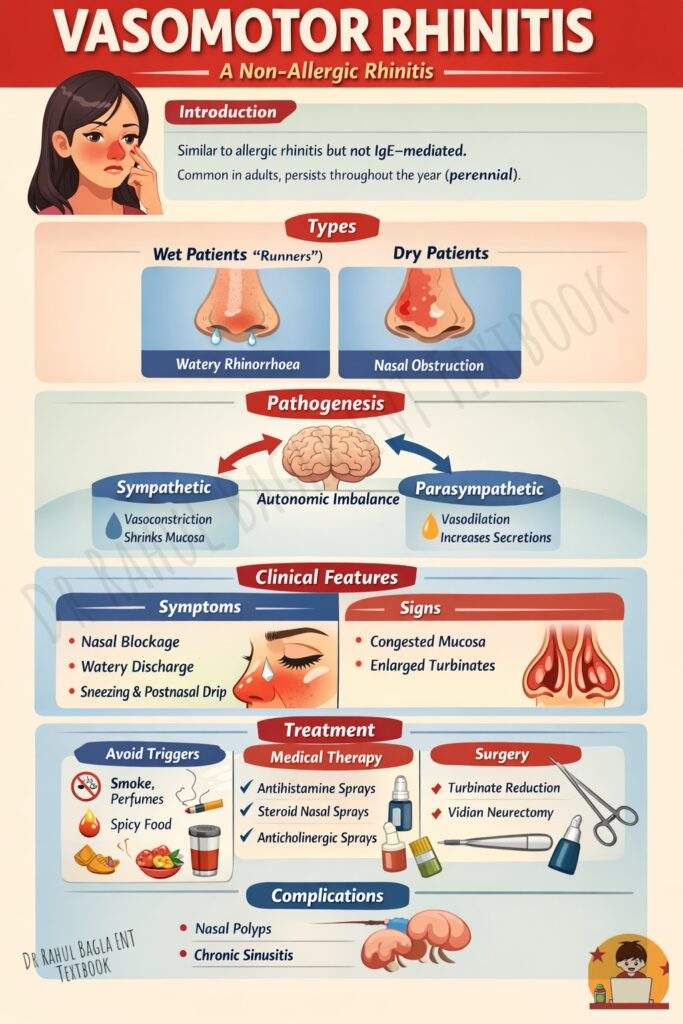
Vasomotor rhinitis is a type of non-allergic rhinitis that clinically resembles allergic rhinitis. However, it does not involve IgE-mediated hypersensitivity. Therefore, vasomotor rhinitis is diagnosed only after excluding allergic rhinitis through history, examination, and allergy testing. Unlike allergic rhinitis, which may be seasonal, vasomotor rhinitis usually persists throughout the year (perennial) and is seen more often in adults.
Types of Vasomotor Rhinitis
Patients with vasomotor rhinitis do not all present in the same way. Instead, they tend to fall into two broad clinical patterns.
- Wet Patients (“Runners”). These individuals mainly complain of profuse watery nasal discharge, which becomes their most troublesome symptom. This occurs because of increased glandular secretion driven by cholinergic (parasympathetic) overactivity.
- Dry Patients. In contrast, “dry type” patients predominantly experience nasal obstruction with minimal or no discharge. These patients have increased sensitivity of sensory (nociceptive) nerve endings in the nasal mucosa, which leads to exaggerated responses even to mild stimuli.
Pathogenesis
The exact cause of vasomotor rhinitis is not fully understood, but the central mechanism involves an imbalance in the autonomic nervous system.
The nasal mucosa contains a rich vascular network with venous sinusoids that behave like erectile tissue. These sinusoids regulate nasal airflow by alternating between congestion and decongestion.
- When the sympathetic system is activated, it produces vasoconstriction. This shrinks the mucosa and improves nasal airflow.
- When the parasympathetic system is activated, it causes vasodilation, mucosal swelling, and increased nasal secretions.
In vasomotor rhinitis, parasympathetic overactivity dominates, leading to persistent mucosal congestion and excessive secretion. At the same time, the nasal mucosa becomes hyper-reactive, responding excessively to trivial environmental stimuli such as cold air, humidity changes, smoke, or strong odours.
The hypothalamus, which regulates autonomic function, also explains why emotional stress and psychological factors can trigger or worsen symptoms.
Recent concepts further suggest that vasomotor rhinitis involves non-IgE inflammation, increased mucosal permeability, and abnormal neurogenic reflexes. This makes the nasal lining unusually sensitive even to harmless triggers such as cold air, smoke, or strong smells.
Clinical features
Symptoms. Patients typically present with a combination of symptoms that resemble allergic rhinitis, but with a key difference—allergy tests are negative. The most common complaints include persistent nasal obstruction, watery rhinorrhoea, bouts of sneezing (often worse in the morning), and postnasal drip. These symptoms often fluctuate and are triggered by environmental factors such as temperature changes, strong smells, smoke exposure, spicy food, or emotional stress.
Signs. Anterior rhinoscopy may show congested nasal mucosa and hypertrophied turbinates, although the mucosa may sometimes appear normal between episodes.
Complications
Long-standing non-allergic rhinitis may involve turbinate hypertrophy. Chronic rhinosinusitis and nasal polyps may coexist with non-allergic rhinitis and should be considered when symptoms persist or are atypical.
2. Occupational Rhinitis
Occupational rhinitis is rhinitis caused or worsened by exposure to specific substances in the workplace. Workplace allergens may trigger an IgE-mediated (type I) hypersensitivity reaction. A late-phase inflammatory response may occur several hours after the initial reaction.
Occupational agents can be broadly classified as:
- High-molecular-weight (HMW) agents: Animal and plant proteins, such as flour, laboratory animal proteins, and latex.
- Low-molecular-weight (LMW) agents: Chemicals such as isocyanates and acid anhydrides.
When an IgE-mediated mechanism is suspected, skin-prick testing or serum allergen-specific IgE can help identify the responsible allergen.
Management
Management includes:
- Avoiding or reducing workplace exposure
- Pharmacotherapy, particularly intranasal corticosteroids
- Allergen immunotherapy in selected patients when an appropriate allergen-specific indication exists
Patients with occupational rhinitis should also be assessed for occupational asthma, as both conditions may occur together.
3. Hormonal Rhinitis
Hormonal changes can cause or aggravate nasal congestion and rhinorrhoea. Pregnancy rhinitis is the best-known example and is characterised by persistent nasal obstruction or rhinorrhoea developing during pregnancy without another identifiable cause. It is thought to be related to hormonal effects on the nasal mucosa and its vascular and glandular components. Symptoms usually improve after delivery. Nasal symptoms may also occur during puberty and in certain endocrine disorders. Management is generally conservative and should take into account the underlying hormonal state and the safety of medications, particularly during pregnancy. The cumulative incidence of pregnancy rhinitis is 22%, and in women who smoke, there is a relative risk enhancement of 69%.
4. Drug-Induced Rhinitis
Several systemic and topical medications can cause or worsen rhinitis. Important drugs include NSAIDs, β-blockers, ACE inhibitors, methyldopa, oral contraceptives and some psychotropic medications. The clinical presentation varies according to the drug and individual susceptibility. NSAIDs, particularly aspirin in susceptible patients, may cause or aggravate rhinorrhoea and may occur as part of a clinical syndrome associated with asthma and nasal polyps. Medication history should therefore be an important part of the evaluation of patients with persistent rhinitis.
5. Rhinitis Medicamentosa
Rhinitis medicamentosa is a form of drug-induced rhinitis characterised by rebound nasal congestion following prolonged or excessive use of topical nasal vasoconstrictors. Commonly implicated drugs include oxymetazoline, xylometazoline and naphazoline. Initially, these medications produce nasal decongestion through vasoconstriction. With prolonged use, however, patients may develop persistent mucosal congestion and become dependent on repeated administration for symptomatic relief. This creates a cycle of increasing decongestant use and worsening nasal obstruction. Long-term use of topical nasal vasoconstrictors should therefore be avoided. Topical decongestant overuse → rebound congestion → rhinitis medicamentosa
6. Non-Allergic Rhinitis with Eosinophilia Syndrome (NARES)
Non-allergic rhinitis with eosinophilia syndrome (NARES) is characterised by chronic rhinitis symptoms with increased eosinophils (>20%) in nasal secretions despite negative allergy testing. Patients typically present with perennial sneezing, profuse watery rhinorrhoea and nasal obstruction, while nasal itching and reduced sense of smell may also occur. The exact mechanism remains uncertain, but eosinophilic inflammation is an important feature. NARES is clinically important because some patients may subsequently develop nasal polyps or asthma. Nasal cytology may help identify eosinophilia in selected patients. Rhinitis + nasal eosinophilia + negative allergy testing → think NARES
7. Gustatory Rhinitis
Gustatory rhinitis is characterised by profuse watery rhinorrhoea occurring during or shortly after eating, particularly after consumption of hot or spicy foods. Capsaicin and other food-related stimuli can activate sensory nerve pathways and increase nasal glandular secretion. Unlike food allergy, gustatory rhinitis is not an IgE-mediated allergic reaction and usually occurs without systemic allergic manifestations. The diagnosis is primarily clinical, based on the characteristic relationship between eating and rhinorrhoea. Eating → watery rhinorrhoea → gustatory rhinitis
Local Allergic Rhinitis (LAR)
Local allergic rhinitis is a localised nasal allergic response with a negative skin prick test and undetectable IgE levels to aeroallergens. Patients may have nasal-specific IgE or a positive nasal allergen provocation test. As these tests are rarely available, the patient may be diagnosed as having NAR, but the symptoms and history may point to an allergy. They respond well to topical steroids.
Diagnosis of Non-Allergic Rhinitis
There is no single test that confirms all forms of NAR. Diagnosis is mainly based on history, examination and exclusion of other causes.
1. History: Ask about:
- Symptoms: nasal obstruction, rhinorrhoea, sneezing, itching and loss of smell
- Pattern: intermittent or persistent; seasonal or perennial
- Triggers: cold air, temperature changes, smoke, perfumes, fumes and eating
- Medications: especially topical nasal decongestants and NSAIDs
- Occupational exposure: symptoms related to workplace
- Associated disease: asthma, nasal polyps and chronic sinus symptoms
2. Nasal Examination: Anterior rhinoscopy assesses mucosal changes, turbinate enlargement, discharge and structural abnormalities. Nasal endoscopy is useful when polyps, chronic rhinosinusitis, unilateral disease or structural lesions are suspected.
3. Exclude Allergic Rhinitis: When allergy is suspected, perform:
- Skin-prick testing
- Serum-specific IgE
Interpret the results together with the clinical history. If systemic allergy tests are negative despite a strong allergic pattern, local allergic rhinitis (LAR) should be considered.
4. Consider NARES: Nasal cytology may show increased eosinophils. A nasal eosinophil count of >20% has traditionally been used as a supportive criterion for NARES, but this is not an absolute cutoff.
5. Further Investigations: CT of the paranasal sinuses is not routinely required in uncomplicated NAR. Use CT or specialised tests such as nasal allergen provocation only when the clinical picture suggests another disease or LAR.
Treatment of Non-Allergic Rhinitis
Treatment should be individualised according to the predominant symptom, trigger and underlying subtype. The first step is to identify relevant triggers and treat the dominant symptom.
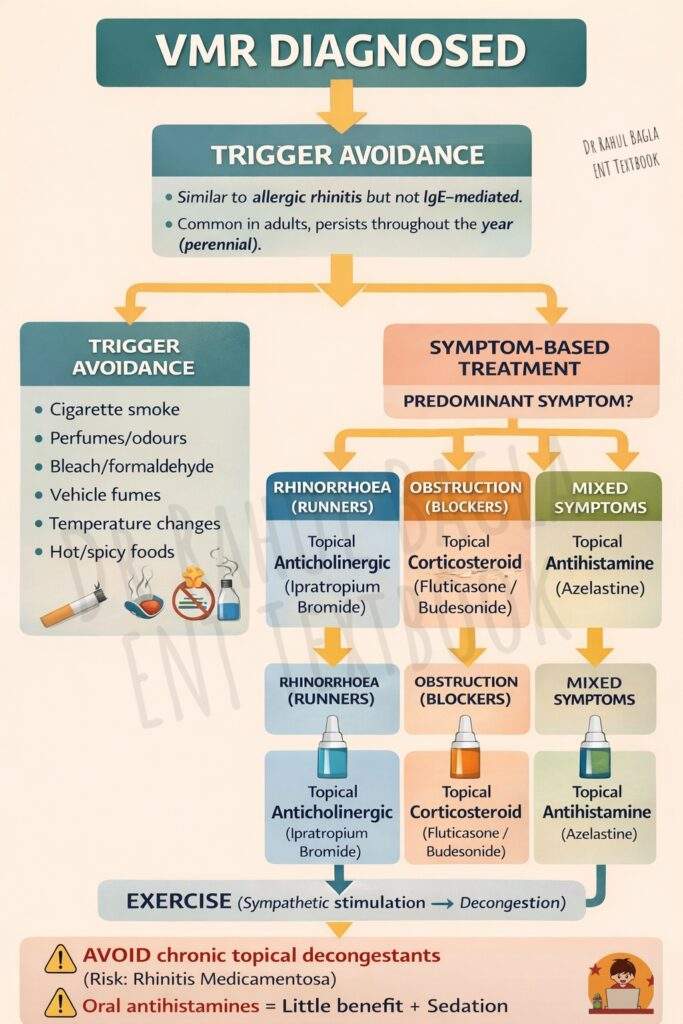
- Trigger Avoidance: Avoidance of relevant triggers is particularly important in occupational, drug-induced and food-induced rhinitis. Common nonspecific triggers include smoke, strong odours, perfumes, chemical fumes, pollution and sudden temperature changes.
- Exercise: Regular exercise improves nasal airflow by stimulating the sympathetic nervous system, which produces nasal decongestion.
- Intranasal Antihistamines: Azelastine is an important treatment option for idiopathic NAR. It can improve rhinorrhoea, sneezing, postnasal drip and nasal obstruction, although improvement in congestion may be less consistent. Its effectiveness in NAR does not imply that the patient has IgE-mediated allergy. Intranasal antihistamines may also have anti-inflammatory and neuromodulatory effects.
- Intranasal Corticosteroids: Intranasal corticosteroids are useful in selected patients, particularly when inflammatory features are prominent. Their efficacy in idiopathic or vasomotor rhinitis is variable. They may be particularly useful in inflammatory phenotypes such as NARES.
- Ipratropium Bromide: Ipratropium bromide is particularly useful when watery rhinorrhoea is the predominant symptom. It reduces glandular secretion and is especially useful in the runner phenotype and gustatory rhinitis.
- Combination Therapy: When symptoms remain inadequately controlled with monotherapy, an intranasal corticosteroid plus intranasal antihistamine may be considered.
- Oral Antihistamines: Oral antihistamines have a less predictable role in pure NAR than in allergic rhinitis. Therefore, they should not automatically be prescribed simply because sneezing or rhinorrhoea is present. They become more relevant when allergic rhinitis or another histamine-mediated component is suspected.
- Topical Nasal Decongestants: Topical vasoconstrictors may provide temporary relief of nasal obstruction. However, prolonged or excessive use can cause rhinitis medicamentosa. Therefore, they should be restricted to short-term use.
- Capsaicin:Intranasal capsaicin has been investigated particularly for idiopathic NAR, possibly by reducing abnormal sensory neural responses. A 2015 Cochrane review found capsaicin beneficial compared with placebo.
Surgical Treatment
- Turbinate Surgery: Turbinate reduction or lateralisation may improve nasal airflow when persistent turbinate-related obstruction remains despite appropriate medical treatment.
- Posterior Nasal Nerve Procedures: Posterior nasal nerve-targeted procedures are a more recent treatment option for selected patients with troublesome rhinorrhoea. They can reduce parasympathetic secretomotor activity and nasal glandular secretion.
- Vidian Neurectomy: Vidian neurectomy reduces parasympathetic secretomotor input to the nasal mucosa. It has historically been used for severe refractory rhinorrhoea. However, outcomes can vary, and the procedure is now used much less commonly because interruption of parasympathetic fibres to the lacrimal gland can cause dry eye. Therefore, it should not be presented as routine treatment for uncomplicated NAR.
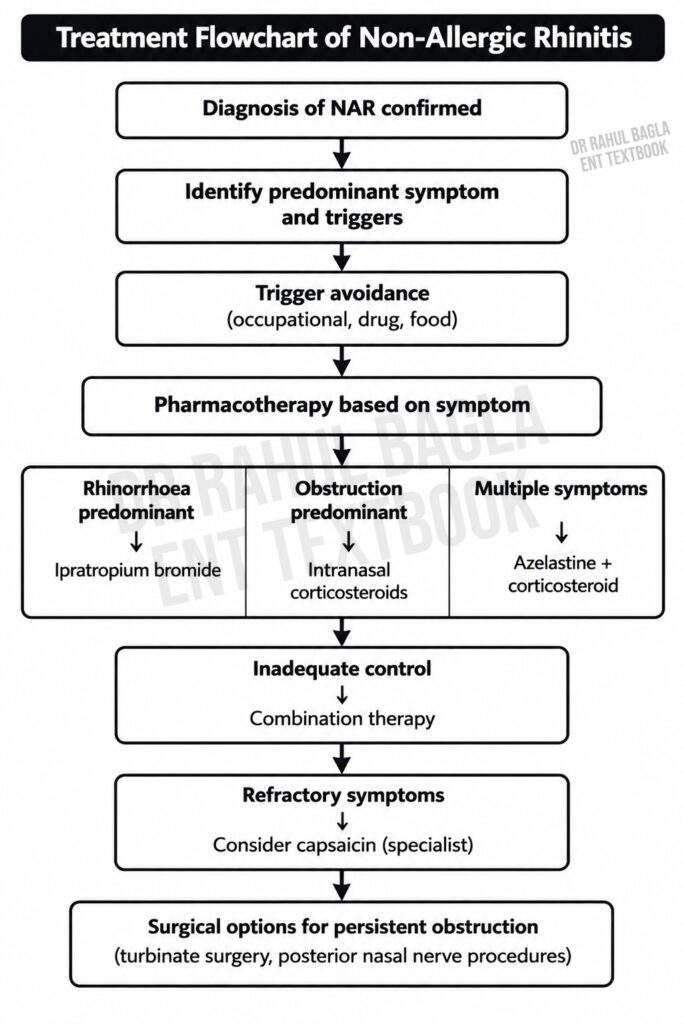
Table: Allergic Rhinitis Versus Non-Allergic Rhinitis
| Feature | Allergic Rhinitis | Non-Allergic Rhinitis |
| Basic mechanism | IgE-mediated allergic inflammation | Nasal hyperresponsiveness with neural, vascular and/or non-IgE inflammatory mechanisms |
| Typical age | Common in children and young adults, but can occur at any age | More common in adults, particularly with increasing age |
| Typical triggers | Specific allergens such as pollen, house dust mites, moulds and animal dander | Non-specific triggers such as cold air, temperature changes, smoke, perfumes, strong odours and chemical fumes |
| Nasal itching | Prominent | Usually absent or less prominent |
| Ocular symptoms | Common, particularly itching, watering and redness | Usually absent or less prominent |
| Allergy testing | Usually demonstrates relevant sensitization on skin-prick testing or serum-specific IgE testing | Usually negative on systemic allergy testing |
| Nasal hyperresponsiveness | May occur | Common, particularly in idiopathic rhinitis |
| Response to antihistamines | Usually beneficial, particularly for sneezing, itching and rhinorrhoea | Intranasal antihistamines may be beneficial; oral antihistamines have a less predictable effect |
| Treatment | Allergen avoidance, intranasal corticosteroids, antihistamines ± allergen immunotherapy | Trigger avoidance, intranasal corticosteroids or antihistamines; ipratropium for predominant watery rhinorrhoea |
——– End——–
High-Yield Points for NEET PG and University Exams
- Non-allergic rhinitis is diagnosed when rhinitis symptoms occur without identifiable allergy.
- Idiopathic rhinitis (vasomotor rhinitis) is the most common type of NAR.
- NARES: >20% eosinophils in nasal smear; may be an early expression of aspirin triad.
- Rhinitis medicamentosa: Caused by overuse of topical decongestants.
- Pregnancy rhinitis: Self-limiting; resolves after childbirth.
- Atrophic rhinitis: Ozaena, thick crusts, enlarged nasal cavities.
- Local allergic rhinitis: Negative SPT but positive nasal provocation test; responds to topical steroids.
- Treatment of NAR: Ipratropium for rhinorrhoea; azelastine and topical steroids for mainstay; capsaicin for refractory cases.
- Vidian neurectomy: Reduces parasympathetic secretomotor input; risk of dry eye.
- Posterior nasal nerve procedures: Newer option for refractory rhinorrhoea.
NEET PG-Style MCQs
- A 45-year-old male presents with perennial sneezing, profuse watery rhinorrhoea, and nasal pruritus. Allergy testing is negative. Nasal smear shows >20% eosinophils. What is the most likely diagnosis? A. Allergic rhinitis B. NARES C. Vasomotor rhinitis D. Atrophic rhinitis.
- A patient on topical xylometazoline for 3 weeks presents with worsening nasal obstruction. What is the most likely diagnosis? A. Allergic rhinitis B. Rhinitis medicamentosa C. NARES D. Atrophic rhinitis.
- Which of the following is the treatment of choice for nasal hypersecretion in non-allergic rhinitis? A. Oral antihistamine B. Intranasal ipratropium bromide C. Topical decongestant D. Oral corticosteroid.
- A 30-year-old pregnant female presents with nasal obstruction and rhinorrhoea. What is the most appropriate management? A. Oral antihistamine B. Topical decongestant C. Hypertonic saline douches D. Oral corticosteroid.
- Which organism is associated with primary atrophic rhinitis? A. Staphylococcus aureus B. Klebsiella ozaenae C. Pseudomonas aeruginosa D. Streptococcus pneumoniae.
- A 50-year-old male with a history of chronic cocaine use presents with nasal crusting and a foul smell. On examination, he has a large septal perforation. What is the most important investigation to order next? A. Fungal culture B. Biopsy from the edge of the perforation C. Serum ACE levels D. Sweat chloride test.
- Which of the following is NOT a typical feature of non-allergic rhinitis? A. Nasal obstruction B. Watery rhinorrhoea C. Prominent nasal itching D. Postnasal drip.
- A patient with non-allergic rhinitis does not respond to intranasal corticosteroids. What is the most appropriate next step? A. Increase the dose of intranasal corticosteroid B. Add oral antihistamine C. Consider capsaicin under specialist supervision D. Start oral decongestant.
- Which of the following is the mechanism of action of capsaicin in non-allergic rhinitis? A. Reduces abnormal sensory neural responses B. Blocks histamine receptors C. Reduces parasympathetic secretomotor activity D. Causes vasoconstriction.
- A 35-year-old male presents with watery rhinorrhoea triggered by eating spicy food. What is the most likely diagnosis? A. Allergic rhinitis B. Gustatory rhinitis C. NARES D. Rhinitis medicamentosa.
Answer Key: 1: B. 2: B. 3: B. 4: C. 5: B. 6: B. 7: C. 8: C. 9: A. 10: B.
Clinical Case Scenarios for Practical Exams and Viva
Case 1. A 45-year-old male presents with perennial sneezing, profuse watery rhinorrhoea, and nasal pruritus. Allergy testing is negative. Nasal smear shows >20% eosinophils. Most likely diagnosis: NARES. Best investigation: Nasal cytology. Best management: Intranasal corticosteroids; consider aspirin challenge only under specialist supervision if N-ERD suspected.
Case 2. A 30-year-old pregnant female presents with nasal obstruction and rhinorrhoea. Most likely diagnosis: Pregnancy rhinitis. Best management: Conservative treatment with hypertonic saline douches; avoid systemic decongestants and corticosteroids unless absolutely necessary.
Case 3. A patient on topical xylometazoline for 3 weeks presents with worsening nasal obstruction. Most likely diagnosis: Rhinitis medicamentosa. Best management: Discontinue the offending decongestant; use intranasal corticosteroids to control rebound congestion.
Case 4. A 50-year-old male with a history of chronic cocaine use presents with nasal crusting and a foul smell. On examination, he has a large septal perforation. Most likely diagnosis: Cocaine-induced septal perforation. Best next step: Biopsy from the edge of the perforation to exclude malignancy or granulomatous disease.
Frequently Asked Questions
- What is non-allergic rhinitis? Non-allergic rhinitis is a group of rhinitis disorders that cause symptoms such as nasal obstruction, watery rhinorrhoea and sneezing without an identifiable allergic cause.
- What are the symptoms of non-allergic rhinitis? The common symptoms are nasal obstruction, watery rhinorrhoea, sneezing and postnasal drip. Symptoms may worsen with smoke, perfumes, strong odours, cold air, temperature changes or eating.
- What is the difference between allergic and non-allergic rhinitis? Allergic rhinitis is associated with an IgE-mediated response to specific allergens, whereas non-allergic rhinitis is not primarily caused by an IgE-mediated allergic reaction. Allergy testing is usually negative in NAR.
- Is vasomotor rhinitis the same as non-allergic rhinitis? Vasomotor rhinitis is a commonly used term for an idiopathic form of non-allergic rhinitis. Non-allergic rhinitis is the broader clinical category.
- What is the treatment for non-allergic rhinitis? Treatment depends on the predominant symptoms. Intranasal corticosteroids or intranasal antihistamines may be useful, while intranasal ipratropium is particularly useful when watery rhinorrhoea is the dominant symptom.
- Which drug is commonly used for watery rhinorrhoea in non-allergic rhinitis? Intranasal ipratropium is particularly useful for reducing watery rhinorrhoea because it decreases nasal glandular secretion.
- What is NARES? NARES stands for non-allergic rhinitis with eosinophilia syndrome. It describes rhinitis with increased nasal eosinophils despite the absence of demonstrable systemic allergy.
- What is gustatory rhinitis? Gustatory rhinitis is a form of non-allergic rhinitis in which eating, particularly spicy or hot foods, triggers profuse watery rhinorrhoea.
- What is rhinitis medicamentosa? Rhinitis medicamentosa is rebound nasal congestion associated with prolonged or excessive use of topical nasal vasoconstrictor decongestants.
- Can non-allergic rhinitis cause nasal obstruction? Yes. Nasal obstruction is one of the most common symptoms of non-allergic rhinitis and may fluctuate according to environmental triggers and the patient’s predominant phenotype.
——– End——–
Reference Textbooks.
- Scott-Brown, Textbook of Otorhinolaryngology-Head and Neck Surgery.
- Cummings, Otolaryngology-Head and Neck Surgery.
- Stell and Maran’s, Textbook of Head and Neck Surgery and Oncology.
- Ballenger’s, Otorhinolaryngology Head And Neck Surgery
- P L Dhingra, Textbook of Diseases of Ear, Nose and Throat.
- Hazarika P, Textbook of Ear Nose Throat And Head Neck Surgery Clinical Practical.
- Mohan Bansal, Textbook of Diseases of Ear, Nose and Throat Head and Neck Surgery.
- Hans Behrbohm, Textbook of Ear, Nose, and Throat Diseases With Head and Neck Surgery.
- Logan Turner, Textbook of Diseases of The Nose, Throat and Ear Head And Neck Surgery.
Author:

Dr. Rahul Bagla
MBBS (MAMC, Delhi) MS ENT (UCMS, Delhi)
Fellow Rhinoplasty & Facial Plastic Surgery.
Renowned Teaching Faculty
Mail: msrahulbagla@gmail.com
India
———– Follow us on social media ————
- Follow our Facebook page: https://www.facebook.com/Dr.Rahul.Bagla.UCMS
- Follow our Instagram page: https://www.instagram.com/dr.rahulbagla/
- Subscribe to our Youtube channel: https://www.youtube.com/@Drrahulbagla
- Please read. Anatomy of External Ear. https://www.entlecture.com/anatomy-of-ear/
- Please read. Anatomy of Temporal Bone. https://www.entlecture.com/anatomy-of-temporal-bone/
- Please read. Stenger’s, Chimani Moos, Teal test. https://www.entlecture.com/special-tuning-fork-tests/
Keywords: Vasomotor rhinitis notes for MBBS students, Vasomotor rhinitis ENT exam guide, Vasomotor rhinitis NEET PG MCQs, Non-allergic rhinitis causes and treatment ENT, Vasomotor rhinitis symptoms diagnosis management, Vasomotor rhinitis summary ENT residents, Difference between allergic rhinitis and vasomotor rhinitis, Vasomotor rhinitis CBME ENT notes, Vidian neurectomy indications ENT, Rhinorrhoea causes ENT revision notes