
|
The following CBME core competencies are covered in this chapter.
|
Presbycusis (Age-related hearing loss or Age-associated hearing loss)
Introduction
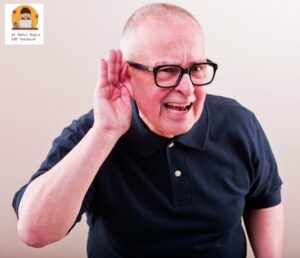
Presbycusis is defined as a gradual, progressive, bilateral, symmetrical sensorineural hearing loss occurring in elderly individuals (typically >65 years), where other identifiable causes of hearing loss have been excluded.
Epidemiology
- The most common cause of hearing loss worldwide
- Prevalence: ~25% of 65-74 years, ~50% of >75 years
- Males > females (possibly due to noise exposure differences)
- Usually affects high frequencies first (4000-8000 Hz)
Clinical Pearl: Patients often say “I can hear you but cannot understand you” — this indicates high-frequency loss affecting speech consonants (f, s, th, k).
Aetiology and Risk Factors
Presbycusis is a multifactorial degenerative disorder; multiple factors contribute to the onset and progression.
- Environmental Factors: Chronic noise exposure (occupational/recreational), Cigarette smoking, Alcohol consumption.
- Hereditary Factors: Genetic predisposition strongly influences the age of onset and rate of progression.
- Associated Comorbidities: Hypertension, Diabetes mellitus, Cardiovascular disease, Cerebrovascular disease, Hyperlipidemia and hyperviscosity states.
These conditions reduce cochlear microcirculation, thereby accelerating cochlear degeneration.
Pathophysiology
- Anatomical Progression: Degeneration typically begins at the basal turn of the cochlea (responsible for high frequencies) and slowly progresses toward the apex (affecting mid and low frequencies).
- Central Changes: Degeneration also involves the spiral ganglion cells, auditory nerve, and central auditory pathways. This explains why speech processing/discrimination can be severely impaired even with mild-to-moderate peripheral hearing loss.
Schuknecht’s Classification of Presbycusis
Schuknecht et al. divided presbycusis into six distinct types based on histopathological studies.
- Sensory. This is characterised by loss of hair cells and sustentacular cells of the organ of Corti, starting at the basal turn of the cochlea, affecting higher frequencies first. Then it progresses gradually to the apex, affecting lower frequencies. Higher frequencies are always more affected, but speech discrimination remains good.
- Neural. This is characterised by degeneration of the cochlear nerve neurons and cochlear spiral ganglion cells. Diagnosis requires a >50% loss of the ~35,500 spiral ganglion cells/cochlear neurons. This decay can propagate all the way up to the auditory cortex. The audiogram shows high-frequency loss (similar to sensory), but the speech discrimination is low or poor and out of proportion to the pure tone loss. Being a neural lesion, there is a low SISI score (less than 30%) and an abnormally high tone decay (usually above 15 dB).
- Strial, Metabolic or Vascular. It is an inherited, slowly progressive subtype of age-related hearing loss caused by the atrophy of the stria vascularis across all turns of the cochlea—particularly the apical and middle turns—which disrupts the vital physical and chemical processes of endocochlear energy production. Because this metabolic failure affects the entire cochlear potential uniformly rather than targeting specific hair cells, it produces a characteristically flat audiogram while leaving speech frequencies and the underlying neural wiring largely intact, resulting in good speech discrimination. Furthermore, because the pathology is strictly localised to the cochlea, auditory testing reveals a classic cochlear profile featuring a positive recruitment test, a high SISI score (above 60%), and a normal tone decay test (15 dB or less), with the overall severity of the hearing loss directly matching the physical degree of strial degeneration.
- Cochlear Conductive or Mechanical. By contrast, stems from structural and mechanical changes within the inner ear machinery rather than a metabolic or neural deficit. It is characterised by an increase in the number of fibrillar layers within the basilar membrane, leading to the stiffening and calcification of the membrane itself and severely altering its physical motion. Because the physics of the cochlea dictate that the basal turn must remain highly flexible to process high-pitched sounds, this structural rigidity penalises high frequencies the most, characteristically manifesting on Pure Tone Audiometry (PTA) as a classic, steeply downward-sloping “ski-sloped” high-frequency sensorineural hearing loss.
There are two other subcategories of presbycusis.
- Intermediate: There are changes in the cochlear duct at the submicroscopic level. There can also be changes in the intracellular organelles, which are involved in cell metabolism. Furthermore, there can be changes in endolymph composition and a reduction in synapse numbers.
- Mixed: A combination of the other five subtypes. The mixed presbycusis term is used when there is a combination of the two more types of presbycusis.
Clinical Features
1. Hearing Loss:
- Onset & Progression: Insidious (gradual) onset, progressive in nature, and it is bilaterally symmetrical.
- The “Cocktail Party” Effect: Severe difficulty understanding speech in the presence of background noise.
- Clarity vs. Loudness: Patients complain of a lack of clarity of the sound (“I can hear, but I cannot understand”) rather than just a decrease in volume.
2. Tinnitus: A very common presenting or accompanying complaint; typically high-pitched.
3. Recruitment Phenomenon: An abnormal growth in the perception of loudness. Soft sounds are not heard, but moderately loud sounds quickly become intolerably loud or painful. (Classic feature of cochlear pathology, notably absent in pure neural presbycusis).
4. Psychosocial & Systemic Impact:
- Increased risk of cognitive decline and dementia.
- Higher incidence of falls due to vestibular-auditory decay.
- Social isolation, depression, and anxiety.
Diagnostic Approach and Investigations
- History: Ask about gradual bilateral hearing loss, difficulty understanding speech in noise (classic), tinnitus, risk factors (noise, smoking, HTN, diabetes), and family history.
- Otoscopy: Must be normal after removing cerumen – excludes conductive causes like wax, perforation, or effusion.
- Pure Tone Audiometry (PTA): In early presbycusis, you will observe a mild high-frequency sensorineural hearing loss, typically affecting 4000 Hz and 8000 Hz first. As the condition advances, the mid-frequencies (1000 Hz and 2000 Hz) become involved, and eventually, low frequencies (250 Hz and 500 Hz) may also show elevation. The typical pattern is a bilateral, symmetrical, sloping (descending) curve. Air-bone gaps are absent, confirming the sensorineural nature of the loss.
- Speech Audiometry: There is a good speech discrimination score present in sensory/strial types. But there is a poor discrimination score, which is out of proportion to the PTA loss in neural type.
- Special tests (SISI & tone decay): There is Low SISI (<30%) and high tone decay (>15 dB) in neural type, and high SISI (>60%) and normal tone decay in strial type.
- Imaging (MRI): Not routine – only for asymmetric loss or suspected retrocochlear pathology (e.g., vestibular schwannoma).
Treatment
Non-specific (Psychological)
- Counselling patient & family
- Communication strategies: face-to-face, reduce background noise, speak clearly (don’t shout), rephrase, use visual cues
- Environmental: wireless TV headphones, louder doorbells, flashing alerts
- Lip-reading classes for profound loss
Specific
- Binaural hearing aids – first-line; modern digital with noise reduction
- Cochlear implant – for profound loss with no benefit from hearing aids (age not a contraindication)
Tinnitus management
- Tinnitus retraining therapy (TRT) – sound therapy + counselling
- Reduce smoking, caffeine (tea/coffee)
Medical
-
Control HTN, diabetes, hyperlipidemia – may slow progression
———— End of the chapter ————
High-Yield Points
- Presbycusis is defined as progressive bilateral sensorineural hearing loss in mid to late adult onset after excluding other causes.
- It is the most common cause of hearing loss in patients over 65 years of age.
- Schuknecht classified presbycusis into six types: Sensory, Neural, Strial (Metabolic), Cochlear Conductive (Mechanical), Intermediate, and Mixed.
- Sensory presbycusis shows hair cell loss starting at the basal turn, causing high-frequency loss with good speech discrimination.
- Neural presbycusis shows spiral ganglion loss, causing poor speech discrimination out of proportion to pure tone loss, low SISI score (<30%), and high tone decay (>15 dB).
- Strial presbycusis shows stria vascularis atrophy, causing a flat audiogram with good speech discrimination, a high SISI score (>60%), and normal tone decay. It runs in families.
- Cochlear conductive presbycusis shows basilar membrane stiffening, causing a ski-sloped audiogram.
- Mixed presbycusis is the most common clinical type, combining two or more pathologies.
- The classic patient complaint is difficulty understanding speech in background noise, not simply reduced loudness.
- Pure tone audiometry typically shows a bilateral symmetrical sloping sensorineural hearing loss.
- Binaural hearing aids are the mainstay of specific treatment.
- Cochlear implants are indicated for profound loss with no benefit from hearing aids.
- Untreated presbycusis leads to social isolation, depression, falls, and dementia.
- Tinnitus frequently accompanies presbycusis and is managed with tinnitus retraining therapy.
NEET PG-Style MCQs
- Presbycusis is best defined as: A. Sudden unilateral SNHL in the elderly B. Progressive bilateral SNHL due to ageing after excluding other causes C. Conductive hearing loss due to ossicular fixation D. Fluctuating low-frequency SNHL with vertigo.
- The most characteristic clinical complaint in presbycusis is: A. Severe otalgia B. Sudden deafness C. Difficulty understanding speech in noisy surroundings D. Episodic vertigo.
- Neural presbycusis is characterised by: A. Flat audiogram and excellent speech discrimination B. Conductive hearing loss C. Poor speech discrimination out of proportion to pure tone loss D. 4 kHz notch.
- Which type of presbycusis commonly shows a flat audiogram: A. Sensory B. Strial (metabolic) C. Mechanical D. Intermediate.
- A typical PTA finding in early presbycusis is: A. Rising curve B. Sloping high-frequency SNHL C. Carhart notch D. Air-bone gap.
- The histopathological hallmark of sensory presbycusis is: A. Spiral ganglion degeneration B. Stria vascularis atrophy C. Hair cell loss beginning in the basal turn D. Endolymphatic hydrops.
- Low SISI score and increased tone decay are typical of: A. Strial presbycusis B. Neural presbycusis C. Sensory presbycusis D. Otosclerosis.
- The mainstay of treatment of presbycusis is: A. Stapedectomy B. Counselling and binaural hearing aids C. Antibiotics and steroids D. Tympanoplasty.
- The best indication for MRI in suspected presbycusis is: A. Bilateral symmetrical high-frequency loss B. Normal tympanometry C. Asymmetrical SNHL with unilateral tinnitus D. Recruitment phenomenon.
- Which type of presbycusis shows a strong familial tendency: A. Sensory B. Neural C. Strial presbycusis D. Mechanical.
Answers: 1: B. 2: C. 3: C. 4: B. 5: B. 6: C. 7: B. 8: B. 9: C. 10: C.
Frequently Asked Questions in Viva
- What is presbycusis? Presbycusis is an age-related progressive bilateral sensorineural hearing loss affecting high frequencies first.
- What is the most common symptom of presbycusis? Difficulty understanding speech in noisy surroundings is the most common symptom.
- What is the typical audiogram in presbycusis? Bilateral symmetrical sloping high-frequency sensorineural hearing loss is typical.
- Which type of presbycusis has poor speech discrimination? Neural presbycusis shows poor speech discrimination out of proportion to pure tone loss.
- Which type shows a flat audiogram and runs in families? Strial (metabolic) presbycusis shows a flat audiogram with good speech discrimination and familial tendency.
- Can presbycusis be cured? No, but hearing aids, counselling, and cochlear implants can greatly improve quality of life.
- When is a cochlear implant advised in presbycusis? When severe-profound SNHL shows poor benefit and poor speech discrimination despite hearing aids.
———— End ————
Download full PDF Link:
Presbycusis Best Lecture Notes Dr Rahul Bagla ENT Textbook
Reference Textbooks.
- Scott-Brown, Textbook of Otorhinolaryngology-Head and Neck Surgery.
- Glasscock-Shambaugh, Textbook of Surgery of the Ear.
- P L Dhingra, Textbook of Diseases of Ear, Nose and Throat.
- Hazarika P, Textbook of Ear Nose Throat And Head Neck Surgery Clinical Practical.
- Mohan Bansal, Textbook of Diseases of Ear, Nose and Throat Head and Neck Surgery
- Hans Behrbohm, Textbook of Ear, Nose, and Throat Diseases With Head and Neck Surgery.
- Salah Mansour, Middle Ear Diseases – Advances in Diagnosis and Management.
- Logan Turner, Textbook of Diseases of The Nose, Throat and Ear Head And Neck Surgery.
- Rob and smith, Textbook of Operative surgery.
- Anirban Biswas, Textbook of Clinical Audio-vestibulometry.
- Arnold, U. Ganzer, Textbook of Otorhinolaryngology, Head and Neck Surgery.
Author:

Dr. Rahul Bagla
MBBS (MAMC, Delhi) MS ENT (UCMS, Delhi)
Fellow Rhinoplasty & Facial Plastic Surgery.
Renowned Teaching Faculty
Mail: msrahulbagla@gmail.com
India
———– Follow us on social media ————
- Follow our Facebook page: https://www.facebook.com/Dr.Rahul.Bagla.UCMS
- Follow our Instagram page: https://www.instagram.com/dr.rahulbagla/
- Subscribe to our Youtube channel: https://www.youtube.com/@Drrahulbagla
- Please read. Anatomy of External Ear. https://www.entlecture.com/anatomy-of-ear/
- Please read. Anatomy of Temporal Bone. https://www.entlecture.com/anatomy-of-temporal-bone/
- Please read. Stenger’s, Chimani Moos, Teal test. https://www.entlecture.com/special-tuning-fork-tests/
Keywords: Presbycusis is the most common cause of hearing loss in elderly individuals, typically presenting as bilateral, symmetrical, progressive sensorineural hearing loss that affects high frequencies first. It commonly causes difficulty understanding speech in noisy surroundings, often with tinnitus, and may lead to social withdrawal, depression, falls, and cognitive decline. Understanding its pathophysiology, Schuknecht classification, audiological findings, and management including hearing aids and cochlear implants is essential for university theory, viva, and NEET PG MCQs. Presbycusis notes for mbbs, Presbycusis for neet pg, Age related hearing loss ent, Presbycusis audiogram interpretation, Presbycusis schuknecht classification, Presbycusis differential diagnosis, Presbycusis management guidelines, Presbycusis hearing aids indications, Cochlear implant in presbycusis, Presbycusis viva questions, Presbycusis mcqs with answers, Presbycusis summary for exams, High frequency sensorineural hearing loss causes, Speech discrimination score in presbycusis, Neural presbycusis features, Strial metabolic presbycusis audiogram, Presbycusis vs noise induced hearing loss, Presbycusis vs vestibular schwannoma, Presbycusis counselling points, Pure tone audiometry in presbycusis, Presbycusis cbme ent topic, Presbycusis revision guide, Presbycusis important questions, Presbycusis case presentation, Presbycusis tinnitus management, Recruitment phenomenon in hearing loss, Hearing loss in elderly differential diagnosis, ENT hearing loss mcqs, Presbycusis clinical features and investigations, Presbycusis treatment flowchart.
Well written. Helpful for both PG and MBBS students.